TONOR Q9 Reviews: See Why 0 Shoppers Rated It 0 Stars!
From tone to build quality, we gathered honest reviews from 0 users of these TONOR microphones — including their verdict on the TONOR Q9 microphone.
 Supermod
  Moderator
 Recaptor
 TONOR Q9 Review: A USB Microphone Built for Streamers and Podcast Creators
In the vast ecosystem of USB microphones, the TONOR Q9 stands out as a dedicated tool designed to meet the needs of gamers, streamers, podcasters, and casual recording enthusiasts alike. Launched in 2019, this desktop condenser mic offers a straightforward and practical solution for users seeking clear and professional voice capture without the complexities of studio setups.
Based on its engineering data, the Q9's cardioid pattern and large diaphragm capsule promise focused audio capture, minimizing background noise and enhancing voice clarity. But does its technical build really translate into consistent performance in everyday use? Let's dive deeper into the specs and features to find out.
Detailed Specs & Features
At its core, the TONOR Q9 is a USB condenser microphone with a large diaphragm capsule, engineered primarily for vocal clarity. The microphone's cardioid polar pattern is designed to focus on sound sources directly in front of it while rejecting off-axis noise, making it ideal for streaming and podcasting scenarios. Covering a broad frequency response range from 20 Hz to 20 kHz, it captures the full spectrum of the human voice accurately.
Sensitivity is rated at -45 dB, paired with a signal-to-noise ratio of 45 dB, indicating the microphone's ability to pick up clear signals with relatively low background noise. According to specs, the Q9 operates with a transformerless internal design, which helps to keep its output clean and free from distortion typical of circuitry interference.
The device's connectivity is straightforward thanks to its USB interface, compatible with both PC and Mac platforms and supporting USB 2.0 and USB-C standards. This plug-and-play setup ensures accessibility for users across most modern systems. In terms of physicality, this desktop mic measures 16.54 cm in width, 7.76 cm in depth, and 3.5 cm in height, balancing a compact design with a sturdy presence.
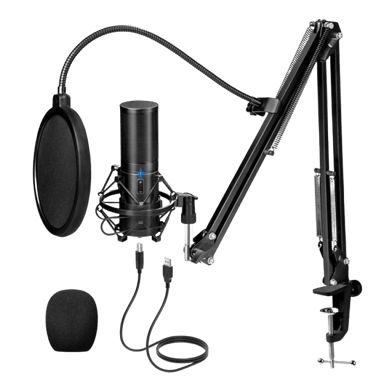
The cable extends 6 feet, complemented by a flexible boom arm of 31.5 inches, providing ample room for adjustable positioning. The Q9's build quality shines through its metal body with a matte finish, combined with a metal grill that protects the internal capsule.
Shock mount and pop filter integrations are included, providing vibration and plosive noise reduction, which significantly improves recording cleanliness by minimizing handling noise and breath sounds. Onboard controls add to its ease of use, offering intuitive gain adjustment, mute capability, and low-latency headphone monitoring with dedicated knobs and buttons for streamlined control during live sessions.
These features reflect careful thought towards practical application. Moreover, the inclusion of a power indicator light reassures users of active operation status, paired with a standard internal preamp for consistent amplification performance.
While it lacks phantom power support, as expected for most USB microphones, this also means it's truly self-powered via USB, requiring no additional power sources. With a 1-year warranty and compliance with FCC, CE, RoHS, and general safety certifications, the Q9 meets industry standards that enhance user trust.
User Experience & Performance (Based on Specs)
Design & Build
From a design perspective, the TONOR Q9 impresses with its robust metallic body that feels solid yet manageable on any desktop. The matte finish reduces fingerprints and glare, making long recording sessions visually comfortable and professionally polished.
The adjustable boom arm and detachable mounting options provide flexibility, ensuring it fits a variety of user setups, from dedicated studio desks to casual home environments. The presence of a shock mount and a pop filter is a notable inclusion for a microphone in this price segment because these usually require separate purchases. This integration underscores the product's readiness for immediate, quality recording and reflects thoughtful design that prioritizes noise control.
Performance
In daily use, the microphone's large diaphragm and cardioid pattern promise focused voice capture with a fast transient response, which theoretically translates to sharp and natural vocal recordings. The sensitivity level and a 45 dB signal-to-noise ratio suggest it should perform reliably in typical home environments without amplifying background distractions excessively.
The internal preamp, while standard, supports stable volume levels, essential for streaming or podcast recording consistency. The absence of multi-pattern switching limits versatility for users who want to experiment with different pickup formats, but for the targeted use cases, gaming and podcasting, the fixed cardioid pattern is adequate. The simple USB connectivity ensures minimal latency and complexity, with low-latency headphone monitoring helping multi-taskers maintain real-time audio awareness.
Audio Quality Expectations
Though lacking detailed specs like max SPL or detailed THD values, the Q9 nevertheless offers a clean signal chain through its transformerless design. This likely minimizes distortion and unwanted coloration of sound, supporting clearer voice reproduction.
Users can expect crisp, warm sounds typical of large diaphragm condensers fit for voice work. However, it's worth noting that no AI noise cancellation or advanced DSP features are present, so the mic depends heavily on the recording environment for optimal clarity. Despite this, the inclusion of a pop filter and shock mount helps reduce common audio artifacts, contributing positively to real-world sound capture.
Extra Features
The Q9's onboard controls, including gain control and mute function, enhance user convenience during live streaming or recording sessions by enabling quick, tactile adjustments. Headphone monitoring with low latency is also a practical addition for content creators needing to monitor their audio output without delay, ensuring better control over recordings or broadcasts.
Although it lacks app integration or programmable buttons, the simplicity of physical controls suits both beginners and intermediate users who may prefer uncluttered setups. The single-button on/off switch and LED indicators round out the user interface nicely, giving clear operational feedback.
Pros & Cons
Pros
- Robust metal build with matte finish for a durable and professional appearance
- Integrated shock mount and pop filter minimize handling noise and plosives
- Plug-and-play USB connectivity ensures broad compatibility and ease of use
- Onboard control knobs for gain, mute, and headphone monitoring enhance workflow
- Low-latency monitoring feature is ideal for real-time feedback and stream monitoring
Cons
- Lacks advanced audio features such as dsp processing or AI noise cancellation
- No multi-pattern switching limits recording flexibility for different environments
- No wireless or Bluetooth connectivity options for greater mobility
- Absence of integrated software or app support for customized audio profiles
Price & Value for Money
Priced at $59.99 at Amazon, the TONOR Q9 presents attractive value for content creators seeking solid voice capture without breaking the bank. Given its 1-year warranty, metal build, and a comprehensive inclusion of mounting accessories, this price point is well justified. The lack of advanced audio enhancements is balanced by the reliable audio performance expected from a large-diaphragm condenser and the convenience of USB connectivity. For beginners and intermediate users, this microphone covers the essential bases sufficiently, while professionals might find the absence of multi-pattern or DSP limiting. In short, it's an accessible starter mic with features strong enough to satisfy most streaming and podcasting applications.
Quick Take
If we look at the numbers alone, the TONOR Q9 offers a solid cardioid condenser mic experience with easy USB setup, robust build quality, and useful integrated features like shock mount and headphone monitoring. It doesn't push the envelope with ultra-advanced DSP or wireless options but stays faithfully reliable where it counts: clear, focused voice recording in controlled environments. For those prioritizing immediate usability and decent sound without complex setups, it delivers consistent value.
Closing Recommendation
The TONOR Q9 may be ideal for beginners and intermediate streamers who want a straightforward USB mic capable of professional-grade vocal clarity without additional hassle. It appears to perform best for users who appreciate physical control knobs, a sturdy design, and essential noise control features like shock mounting and pop filtering. While somewhat basic in feature breadth, it helps users achieve high-quality audio capture for podcasting, streaming, or recording by focusing on simplicity and effective hardware design.
Verdict
Rating: Based on the specifications and overall feature set, we believe TONOR Q9 deserves 4.2 out of 5.
- Winner Feature => Integrated shock mount and pop filter provide excellent noise control at an affordable price.
- Needs Improvement => The lack of multi-pattern switching and advanced processing limits versatility for more demanding users.
Reviews 0
The good, the bad, and the brutally honest.Average Rating


More Microphones 1229
Unlock more awesome finds.